Showing posts with label Evaluation Maisie. Show all posts

Friday, 28 March 2014

1) In what ways does your media product use, develop or challenge forms and conventions of real media products?

Our film 'Consequences' is a British independent drama film with a sub-genre of crime, although this sub-genre is only suggested and not actually shown in the opening. While planning our film, we researched genre, narrative, form and style conventions associated with British drama, and in our opening we both conform to and challenge them.


Genre
In our opening there is a balance between British drama conventions that we conformed to and conventions that we challenged

Convention

Media text reference


Used or challenged?

Themes of crime
Bullet Boy – shows young characters involved in crime

Let Him Have It – follows the protagonist through the after effects of his crime and arrest
Used
Although crime is not actually shown in our opening sequence, it is made obvious the Dan is in serious trouble after being involved in illegal activity
Themes of Romance/relationships
Brighton Rock – the plot is based around the relationship between a gang member and a woman he meets
Used
Our opening shows the romantic relationship between the two main characters
Deals with sensitive issues (racism, sexism, drug abuse, physical abuse, etc)
Trainspotting – deals with drug addiction

East Is East – deals with racism
Challenged
In our film opening we decided to focus on the main elements of the story which are the characters’ lives and the crime they get involved in, so we didn’t include any of these more sensitive types of themes

Urban setting

Kidulthood – set in west London which can be seen behind the character

Attack the Block – set in south London, an urban environment
Used
Our sequence is set in a house and the streets of east London
Focus on working class
Fish Tank – Mia lives on a council estate, from a working class background

This Is England – characters from a working class background

Challenged
Our film focusses on the lives of teenagers from middle class backgrounds

Narrative
  • Our opening sequence follows Todorov's narrative theory in the following way:
  • Todorov's theory continues with a resolution and new equilibrium, and although this is not shown in the opening it comes later in the film. This type of narrative is common in many films of the drama genre, such as Attack the Block and Submarine.
  • Enigma codes were also used in our opening to set up questions like:
    • What exactly happened to Dan and why is he in trouble?
    • Who is Dan running from?
    • Who is Ryan?
    • Who is knocking on the door at the end?
  • Similar questions are set up in the opening of Trainspotting as the audience ask questions like 'why are the characters running from the police?'
Opening scene of Trainspotting

Form and Style
The form and style of a film is important for conveying the genre and feel of the film. We established our form and style using grading, titles and shot types.
  • After looking at other British drama films and TV programmes including Skins, Misfits, and Trainspotting, we decided on the features for our grading (shown below), as they seemed to be typical of the drama genre

  • Our titles are white, plain and simple, and fade in and out, similar to the titles used in British drama film This Is England. The titles are effective in crediting those involved in making the film, but at the same time to not take too much of the viewer's attention away from what is happening in the film.


  • We used varying shot types to make the sequence interesting and keep the audience's attention. This included:
    • Establishing shots
    • Close-ups
    • Wide shots
    • Over-the-shoulder shots


2) How does your media product represent particular social groups?

Our main representations were age and gender

I made a mind map of the conventions of these representations that we considered when planning our story and characters:


Lucy was a challenge to some of these stereotypes:
  • She is shown watching football, a typically male activity which
  • She is a strong-minded and feisty character, similar to Alisha in Misfits who is also portrayed as strong and sassy
Alisha in Misfits
'Lucy' in Consequences  

Dan both conformed to and challenged some of these stereotypes:

Conformities:
  • He is athletic which is expected of boys/men
  • He is, as is common with portrayals of teenagers and more typical of boys, in some kind of trouble with either the law or other people 
  • The crime appears to have involved violence
Kidulthood shows violent young people getting in to trouble
Challenges:
  • He appears to be distressed by the situation, showing him as emotionally vulnerable. this challenges the typically hard exterior put on by male characters in films of our chosen genre, for example the characters in Attack the Block.


Although we conform to a huge age stereotype with the male protagonist getting in to trouble, we also present a challenge to age conventions as neither character is shown to be involved in the drugs/party scene that teenagers are commonly associated with, for example most characters from Skins abuse drugs and constantly party.
Characters in Skins

3) What kind of media institution might distribute your media product and why?

Production
We created our own production company for our film opening, called 'GEMM Productions'

Financing
Our film would qualify for funding from the BFI film fund, as they have said they "work to discover and develop new talent and to support the production of a wide range of films that will enrich British film culture and define Britain and its storytellers in the 21st century, for the benefit of audiences home and abroad". The BFI also typically supports British indie films, making Consequences a strong candidate to receive funds from them.


Distribution

After looking at several distribution companies, we made our choice of distributor for the reasons I explain in this Prezi:


Exhibition 
A cinema release is hugely important for our film as our core target audience (16-24 year olds) are the most frequent cinema-goers and so this is a key way to reach them.

Being distributed by StudioCanal, we expect to be able to make deals with our film to be shown in smaller cinemas in the UK to begin with, such as independent cinemas like the following: 

  • The Phoenix in East Finchley
  • The Screen on the Green in Islington
  • Stratford Picture house

Pictures of the cinemas listed above
These are all situated in London, which means that people who visit these cinemas are most likely to relate to the setting and themes of our film, which is set in East London.

If our film is successful, we feel that it has potential to be shown on TV with channels such as Channel 4 or Film4, as they have made deals for other British independent films including Attack the Block.
Attack the Block listed in past programmes on the Channel 4 website
As the story is likely to only appeal to the UK audience, and largely those who live in cities, we aren't aiming for an international release. However, as StudioCanal is based in France it may be possible, depending on the success of the film, to market the film in France and other European countries, as many young people will be able to relate to some of the themes in our film.

4) Who would be the audience for your media product?

To produce a film to suit a particular demographic it is important to understand the needs of the audience, which is why we chose to target our film at 16-24 year olds in the UK, as we are in this demographic ourselves and so have a thorough understanding of how to attract them. They are also the group which most frequently visit the cinema, as shown in this table from the Cinema Exhibitors' Association website:


Core audience

The Voki below is a characterisation of our core audience 

He is
  • Male - the male audience can relate to our male protagonist and the themes of the film, with the protagonist stereotypically getting in to trouble and having problems with his friendships and relationship.
  • British
  • Aged between 16-24
  • A fan of the drama genre
  • A regular cinema-goer

Secondary audience

The Voki below is a characterisation of our secondary audience

She is
  • Female - the female audience can relate to our female character, 'Lucy', as she is an average teenage girl. As they are seeing the film through the eyes of a character they understand, it may help them to understand themes they might not usually relate to.
    • Another way in which this audience may relate to the film is through having or aspiring to have similar traits to 'Lucy', a strong and independent character.
  • British
  • Aged between 16-24
  • A fan of the drama genre
  • A regular cinema-goer


Both audiences share similar qualities...
  • Interests:
    • It is important that our audiences visit the cinema often as this is our choice of platform for initial exhibition, so money from the box office is key to the success of the film. With a target audience that regularly visit the cinema this is almost guaranteed. 
    • Fans of film and TV dramas are an obvious choice for our target audience as our film's main genre is drama.
  • Nationality: As our film is a British production with a British distributor, it makes sense for our audience to be mainly British as they will be the easiest to target.
  • Age: 16-24 year olds are the most likely to be able to relate to the characters, as 'Lucy' and 'Dan' fall in to this age group.

5) How did you attract/address your audience?

Our core audience was 16-24 year old males and our secondary audience was 16-24 year old females. We kept our audience in mind with every decision we made while planning and producing our film opening.

This Prezi shows how we used characters, setting and representation of relationships to attract and address our audience


We used elements of the narrative to attract our audience
  • The running scene was inspired by the chase scene in the opening of Trainspotting, which is a film with a similar genre and audience to Consequences. As we did more research, we realised that other films and TV shows aimed at 16-24 year olds also featured running sequences.
Trainspotting
Misfits
Attack the Block
The fast paced editing mixed with the enigma of who the character(s) are running from/where they're running to intrigues the audience, which is what we tried to create with our own film opening:


  • The second half of the scene shows the relationship between 'Lucy' and 'Dan', which would typically attract a largely female audience (our secondary audience). Both our audiences will be able to relate to the young couple, but 16-24 year old females are more likely to be attracted by the theme of romance.
  • The themes of violence (not shown but suggested through the dialogue) are likely to attract 16-24 year old males, as films such as Kidulthood and Attack the Block have similar themes and are aimed primarily at this audience.

Music

The genre of the song we chose is drum&bass, which is one of he most popular genres with 16-24 year old males and females, alongside R&B and House music. We chose to go with a drum&bass track not only because this type of music is popular with our audience, but because it is upbeat and suits the mood of the opening.


Feedback from our audience
We created a survey and shared it on Facebook, asking people to give us feedback on our film opening to see how successful we were in appealing to our audience. We received 12 responses from people aged between 15-22.


  • A large majority of people who answered this question thought that our opening sequence was aimed at 16-24 year old males and females, which is exactly who we were aiming it at. This suggests that we effectively used the conventions of films aimed at this audience.


  • A fairly even spread of both our core and secondary audience responded to the survey (shown in the picture on the left), and as shown in the picture on the right, we received generally positive feedback from people who did the survey. This shows that we were successful in appealing to the needs and interests of our target audience.


  • The data shown in the picture below suggests that the genre we were aiming for (drama) was not completely clear, so maybe we didn't use enough conventions of the drama genre to appeal to people who enjoy drama.


Overall, I think we were successful in using different elements of our opening to attract and address 16-24 year old males and females, as we understood the needs and interests of this audience and made decisions based around this knowledge.

6) What have you learnt about the technologies from the process of constructing this product?

We used a range of technologies to plan, shoot and edit our film opening sequence. I became more familiar with and confident in using these technologies during pre-production, production and post-production as they were essential for producing a sequence of a high standard.

The slideshow below explains what I learned from the technology used during production, and some of the advantages and disadvantages of this technology.


We used two main types of technology in post-production: editing software, and the internet

To edit our sequence we use Adobe Premiere Pro. I had only used this program once before but knew the basics of how to work it, and over the course of editing the sequence I added to my skills and confidence in using this editing software.
The timeline we used for the final edit

The main things I learned about Adobe Premiere Pro in the process of this project were how to grade, fade titles in and out, and mix sound .

  • Grading
    • We used a three-way colour corrector within Premiere Pro to adjust the colours of the shots 
    • As well as this we used ProcAmp to adjust brightness, saturation and contrast in each shot 

    • Before and after grading:


Although I wasn't as confident with the grading at first, as it was new to me, after practising and experimenting with it I became more comfortable with my decisions made for the grading of our shots.
  • Our plans for the titles were not too complex, but we still wanted them to look professional. As the title making program that Premiere Pro offered was very basic, we used additional programs to create our titles: 
    • LiveType was used to make the more basic titles, which faded in over the shots and out again. The fading was done using Premiere Pro, by changing the opacity at the beginning, middle and end of the title.


    • I felt that this was a very important skill to learn in terms of editing, as although it is basic it can be very effective for the look and style of the credits.
    • Adobe After Effects was used to create these more complex titles:
 
We did this by masking the title frame by frame in After Effects, and the transferring the clip to Premiere Pro to replace the original. 

  • Some of the sound mixing, especially for the music, was done using Premiere Pro. However, we used an additional program called Adobe Audition to lower the volume of background noise (for example, the whirring of the camera that was picked up by the microphone) and to make the transition from dialogue to silence smoother. PICTURE

After Effects and Audition were both new software that I wasn't familiar with, but I think that by using them for our opening sequence I have greatly improved my technical skills, and learned the importance of having these technical skills for the success of a sequence.


After completing our film opening sequence, we used the internet to get audience feedback. We created a survey on Survey Monkey and shared it on Facebook, asking people to watch our sequence and respond to the questions

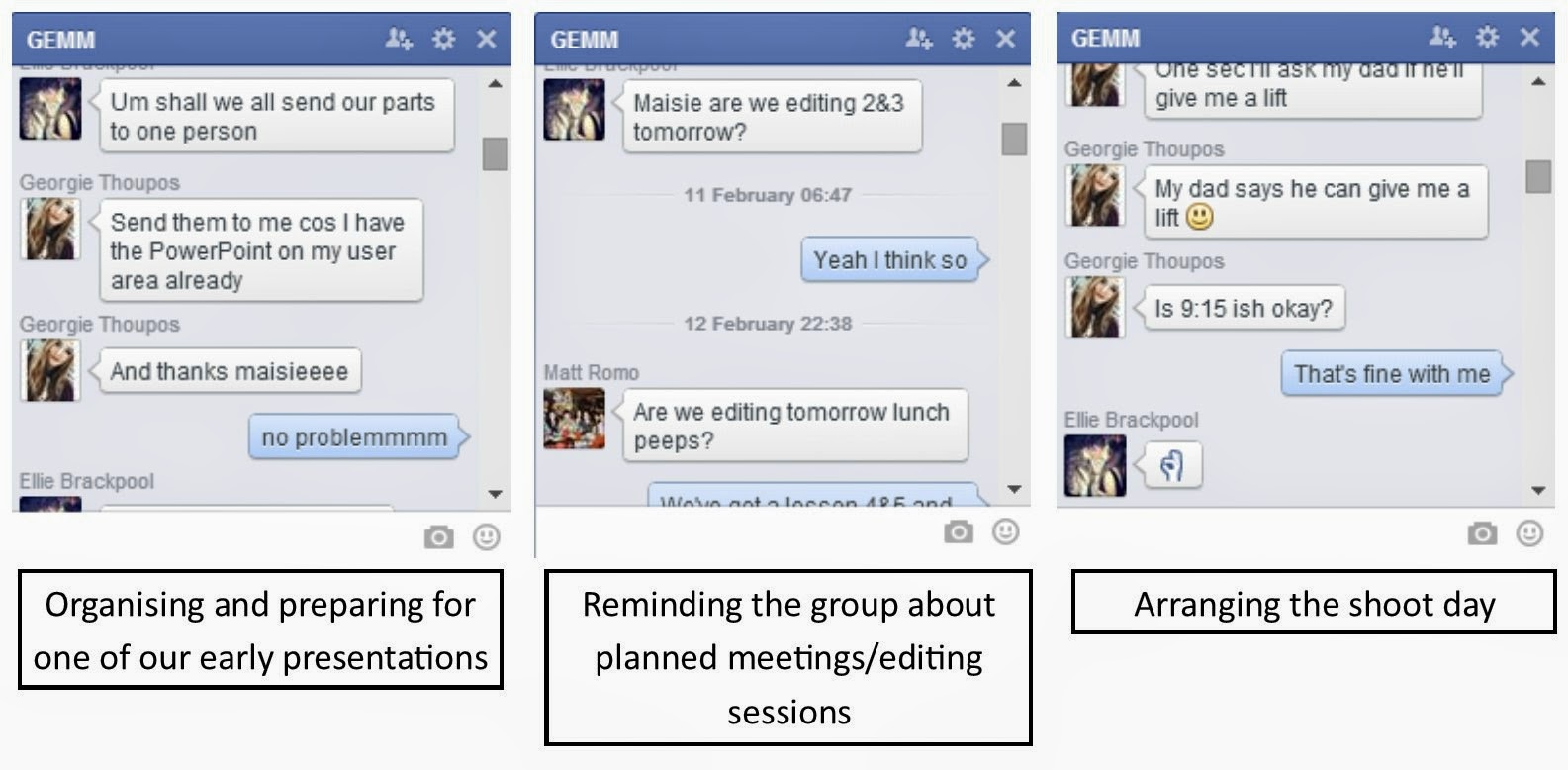
Throughout the entire project we used Facebook for planning and organising. This social media was very useful for several reasons:
  • We were able to send messages between the whole group with a group chat called 'GEMM'
  • Everyone in our group is familiar with how to use Facebook
  • It's free
  • It's accessible at any time of day via computer or phone

From doing this, I learnt the importance of technology in communicating with an audience and receiving feedback. It's much easier than printing and handing out surveys and getting a large group of people to watch and rate the film at one time. It can also be done any time e.g. from home or school, or anywhere with internet access.