Showing posts with label Evaluation Ellie. Show all posts

Thursday, 3 April 2014

1. In what ways does your media product use, develop or challenge forms and conventions of real media products?

The title of our film is 'Consequences'. It is a British drama film focusing on the protagonist 'Dan' and the struggles he faces being a teenage boy in London. The other character introduced in our film opening is Dan's girlfriend 'Lucy'.
In order to produce a successful product, we had to research into the drama genre for the four concepts of film production; genre, narrative, form and style.

Genre

Our film is a British drama, mainly focusing on teenagers.
Here are some films of similar genre:

Kidulthood
Attack The Block
This is England
We used these inspirations in order to find out more about the forms and conventions of our chosen genre, and then chose to focus on specific conventions based on them.

Conventions of similar films:

  • Urban British setting
  • Male protagonist
  • Relationship between male and female
  • Protagonist caught up in disruption 
  • Themes of trouble/crime
  • Realistic appearance (lighting, mise-en-scene)
This is how our we created our characters and setting according to the forms and conventions of a real British drama film:


Form and Style
We wanted our film's appearance to be of a similar style to that of the TV drama 'Skins' and British film 'This Is England'.
The intended effect was to make our film opening as realistic and relatable as possible while satisfying the audience's expectations of quality as well as forms and conventions.

We did this through the use of:

  • varying shot types:


    • diegetic sounds eg. footsteps running, knocking on door
    • natural exterior lighting:


    • plain simple titles; plain white fading in and out:
This Is England titles vs. Consequences titles
Consequences running sequence
Trainspotting running sequ
The content of our opening
was supposed to be shot in the style of the British drama film Trainspotting; using the same sense of pace, movement and action through the running sequence.

Narrative Structure
Often, films conform with Todorov's theory of narrative structure:

However, our film will challenge this theory by beginning with a flash-forward of the disruption, before returning to the equilibrium that would come chronologically first.
This is similar to the way that 'Battle: Los Angeles' begins by throwing the audience into the action leaving them asking various questions about how and why this sequence happened. This creates intrigue and interest which is what we intend to do with our opening sequence.


In order to create a build-up of tension, leaving questions unanswered, we used Barthe's theory of enigma codes. We started the film with the disruption of Dan running away, leaving the audience to question who he is, what he's done and where he's running. We continue to leave questions unanswered, leaving the opening on a cliff-hanger in order to engage and interest the audience.

Wednesday, 2 April 2014

2. How does your media product represent particular social groups?

In our film opening we have focused of the representation of gender, and of that, age.
The following Prezi explains how we have chosen to represent our two main characters, Dan and Lucy.


This Voki is a self-characterisation of the protagonist Dan:


We chose to make our protagonist a conventional teenage male in this way in order to make him a relatable character for our target audience while making him realistic and believable, conventional of the genre.

As well creating representations of individual characters, we wanted to represent British youth as a whole. Rather than representing our characters in an entirely negative way, for example involved in drugs and partying like Skins, or drug-dealing and gun crime like Kidulthood, we wanted to create an entirely realistic representation of British youth. Therefore, our film will have a broad appeal within the 16-24 market as people from different backgrounds will relate. This representation does have some negative factors such as the crime Dan is involved in, however it is supposed to show that teenagers can get involved in these issues without intending to. Our intention is for our film to create a better understanding of British youth rather than a criticism.


One of the main factors we focused on was relationships. We wanted to present young relationships in a realistic way, showing not only how important they can be to teenagers, but also the negative impact they can have when there are problems.
Jay & Claire's relationship in Kidulthood
Positive side of Freddie & Effy's relationship in Skins
Negative side of Freddie & Effy's relationship in skins
Lucy and Dan clearly care about each other (Consequences)
However, Dan's problems have a huge impact on Lucy and this causes tension in their relationship


Tuesday, 1 April 2014

3. What kind of media institution might distribute your media product and why?

Due to the fact that it is a low budget British independent movie, our film would be a co-production between production and distribution.

Production
Our production company is called GEMM Productions.


GEMM Productions is a British independent production company aimed at 16-24 year old male and females as they fulfill a large proportion of the cinema market. We aim to produce films with more challenging and interesting themes than those produced by big-budget studios, focusing on drama with possibilities of comedy or thriller. Our Production company is similar to Film4 which has co-produced many British films including Attack The Block, Submarine, The Inbetweeners Movie and This Is England.

Financing 
Our film would be financed by the BFI Film Fund who 'work to discover and develop new talent and to support the production of a wide range of films that will enrich British film culture and define Britain and its storytellers in the 21st century, for the benefit of audiences at home and abroad'. Therefore, we think due to our film's indie British style and content, we would qualify for funding.

Distribution
We researched various studios and looked at their involvement in the distribution of films.
Here is a mood-board of possible distributors for our film:

After having researched distribution companies, we realise that it would be best to use a distribution company that has distributed a number of films with style and content similar to that of ours. In addition, having great involvement in the British independent film industry would be essential.
Therefore, we decided that our film would be distributed by StudioCanal.


StudioCanal is is a French-based production and distribution company that owns the third-largest film library in the world, therefore are incredibly successful. Our film would probably be distributed by the smaller StudioCanal owned distribution company StudioCanal UK (previously named Optimum Releasing). This is because it has successfully distributed various British drama films similar to ours, for example Attack The Block, This Is England and Submarine

Exhibition
If our film was distributed by StudioCanal UK it is likely to be shown in the cinema. Our target audience of 16-24 year olds are amongst the most prominent cinema goers in the UK, making a theatrical release crucial to the success of our film (see table in Production). However, due to the fact that its a fairly low-budget independent movie we feel that it would have most success initially being shown in independent cinemas in order to appeal to our core audience. Some examples of these cinemas are:
Hackney Picture House
The Phoenix, East Finchley
Hyde Park Picture House, Leeds
If our film was to be a success at these smaller cinemas, we feel that it could be shown in larger cinemas such as Cineworld, Vue and Odeon.


Our film would be shown in 2D as it is low-budget film and the appearance, due to the genre and style, would not benefit sufficiently from the costs of showing it in 3D. In addition, our audience would not expect an independent British drama film to be shown in 3D.

After the success of the cinema, we feel that our film has the potential be shown on Television. It is most likely to be shown on Film4 or Channel4 as other independent films have succesfully been exhibited on these channels:


Due to the increase in revenue from film on television, we feel that showing our film on television would be highly beneficial to us. Overall, theatrical and television exhibition has had the highest proportion of revenue over the last few years implying that these are the two best platforms for exhibiting a film, as shown in this graph from the BFI statistical Yearbook 2013:


http://www.thereelbits.com/wp-content/uploads/2011/07/submarine-poster-AU.jpg
Marketing
Our film would be marketed to our national audience through a simplistic marketing campaign, taking advantage of below-the-line advertising. Due to the majority of our audience being in the urban youth demographic, our marketing would most effectively take place in cities. Similar to the way in which StudioCanal distributed Submarine, we would create one simple poster that would become a memorable image for our film. This would be seen at bus stops and train stations around the main cities in the UK, for example on the London underground. Due to our low budget as an independent film, the poster would not be seen on a large scale, for example on billboards.

In addition to the poster and similar to Submarine, we would have one main trailer available to view online, posted on the StudioCanal UK Youtube channel. This would be shared on our Facebook page which would be the main hub of our film's marketing, sharing all interviews, reviews and any other promotional opportunities directly to our audience of 16-24 year olds in the UK.

Monday, 31 March 2014

4. Who would be the audience for your media product?

In order to produce an effective film opening, it is important to have a good idea of audience and audience's needs and gratifications. We chose to focus on 16-24 year old males and females, not only because we fall within this demographic and so have a strong understanding of their needs, but also because they are avid fans of the drama genre. Due to the fact that our film is very British-based and is an independent film, our target audience will be national rather than global.

Our core audience will be 16-24 year old males in the UK


Here is a mind-map of our Core Audience:
  
Our audience will be predominantly middle class because the protagonist is supposed to relate to the regular middle class teenage boys of the UK. However, the element of crime could relate to a wider audience of lower class teenagers who are involved in gang crime in the UK. Therefore, our film will appeal to most young people around the UK in different ways. They are also likely to be situated in cities such as London and Manchester in order to relate to the city/streets context of the film. Therefore, our film will be predominantly marketed in the main cities of the UK. For example, we will create one simple film poster, placed at bus stops and train stations for example on the London Underground. This will ensure that we are using our limited budget most effectively to reach our target audience.
word-map of core audience's interests and lifestyle
Our secondary audience will be 16-24 year old females in the UK


Here is a mind-map of our Secondary Audience:
 
The type of females we are attempting to target would be relatively feminine and interested in typical things such as clothes and make-up. However, the challenging convention of Lucy being strong and powerful enables us to either target strong girls who can relate, or girls who aspire to be like Lucy. This broadens our female marketability to different types of girls.

word-map of secondary audience's interests and lifestyle

Other Audiences:
From reading about audience distribution in the BFI Statistical Yearbook 2013, I have realised that the 45+ age group have become increasingly prominent cinema-goers. Therefore, I concluded that perhaps we could have included some content to appeal to a tertiary audience of 45+. However, we did aim our film at the second largest age group of cinema-goers.
 

Our film could appeal to those outside of our target audience group as a way of informing them about young people's lives in the UK.

Sunday, 30 March 2014

5. How did you attract/address your audience?

Audience appeal was at the heart of our research, planning and production. We understood that our audiences' needs and gratifications should be constantly considered throughout the project in order to create a successful film opening. Our core audience was 16-24 year old males and our secondary audience 16-24 year old females. 

This slideshow demonstrates how we created our film opening in order to attract & address our Core and Secondary audiences:


We constructed our characters in order to appeal to our audiences in the same way that the films and programmes we focused on did. We wanted to create a protagonist similar to the character Freddie from Skins, who the audience would like and feel empathetic towards while relating to his issues. Some comments on a fan-made video of Freddie included 'I really like Freddie, he is sweet and a very nice person' and 'My favorite character from skins, definitely!'
Lucy was constructed in a more aspirational way; creating a character that girls would feel empathetic towards due to her trouble with Dan, but also someone who is strong and passionate, a quality that some girls would aspire to have. This is similar to the character Mini from Skins; she is a conventional teenage girl but can be strong and powerful when she needs to be.

More on the representation of our characters here

Music
After researching film openings, we realised that music was a very important part of construction. We researched music and soon found out that dubstep/drum&bass are becoming increasingly popular among the 16-24 year old audience. We wanted a song that would not only appeal to our audience, but also attract them by creating a sense of pace and drama. Here is the song that we chose:


I feel that our film opening attracted and addressed our audience incredibly well. However, there were a few things that could've been improved in order to increase audience appeal. For example:
  • include more action in order to make it more exciting and appeal more to boys
  • make the female less dominant as this could put male viewers off, and adheres to audiences' expectations
  • emphasise the type character our protagonist is, for example by putting a focus on gangs, as he does not have a very clear characterisation
In addition to our core and secondary audiences, I feel that we could attract other audiences, for example:
  • those who enjoy independent films/film-making
  • fans of British drama in general
  • those outside of the relatable audience group who want to be informed by the content
  • those outside of the relatable audience group who want to experience escapism
In order to see how successfully we attracted and addressed our audience, we shared our video on Facebook and asked people to fill in a short feedback survey. Overall we received very positive feedback which showed a clear understanding of the story-line, intended audience and type of production.

Here is a selection of our positive audience feedback:


Here is some analysis of our audience feedback focusing on gender:


However, some of our audience didn't correctly pick up on the genre of our film, for example:

After analysing our audience feedback as a whole, I feel that we appealed to our two main audiences incredibly well. However, the confusion over genre implies that we should have included more conventions of the drama genre in order to portray this sufficiently, for example the use of mise-en-scene.

Saturday, 29 March 2014

6. What have you learnt about technologies from the process of constructing this product?

In order to create our media product we had to use and develop our skills and knowledge of various different technologies. Some of which we had used before, others being completely new to us. I found the software the most useful and interesting learning experience, and I now feel very confident and knowledgeable of the programs that we used.

Hardware

We used the Canon Legria HV30 camera to film our opening sequence. We had used this camera before so we were very experienced and knowledgeable of how to use it.
Here are some positives and negatives of using this camera: 
click picture to enlarge

With the camera came a basic tripod which we had previous experience in using. This was incredibly easy and portable to use, and became essential to our sequence. For example, in this wide shot we needed the tripod to keep the shot level:
However, due to the fact that the tripod was quite stiff, it was difficult to take successful pans and therefore led to some shots having to be done hand-held which we did not intend to use. This made some camera movement unintentionally jumpy/shaky, as seen below:


shaky hand-held pan
In addition to this, we used a shot-gun microphone which was placed on top of the camera. Initially in the practice shoot we filmed some shots without using this microphone; there was a very noticeable improvement in the sound quality with the microphone as opposed to without. However, the microphone did tend to pick up a lot of background noise, for example the sound of wind or pedestrians, which meant it took longer to edit the sound mix in post-production.

Some hardware that we had never used before was the Arri Lighting Kit. Before using this, we had a short tutorial on how to use it safely and effectively. After having the tutorial, it was up to us to experiment with the lighting kit during the practice shoot in order to ensure that we knew how to use it effectively for our final shoot. 
From using this lighting kit, we learnt that lighting can greatly affect the quality of shots, especially interior ones.  
Here are some positives and negatives that we experienced from using the lighting kit:
click pictures to enlarge
The lights came with some filters available to use. After having tested these out, we decided that we did not need to use them for our opening sequence as we wanted a natural appearance to the shots, conforming with the style of similar products for example Skins. In addition, we knew that we could apply any effects that we wanted later in the grading part of post-production.

Despite our success with the lighting kit, we did face the problem of placing it successfully in the small room. In this shot, one of the lights is actually visible in the corner of the shot:


Software
In order to edit our film opening, we used Adobe Premiere Pro. As I had used this program multiple times before, I was relatively confident in using it.

Timeline on Adobe Premiere Pro
However, I soon discovered that I had been using this software on quite a basic level. I learned how to grade our footage in a more in-depth way than I had done before, using the three-way colour wheel. This meant that we could carefully create our intended grading effect while ensuring that all footage had the same kind of appearance and style. This is how we graded our shots:
Grading (click here to enlarge)

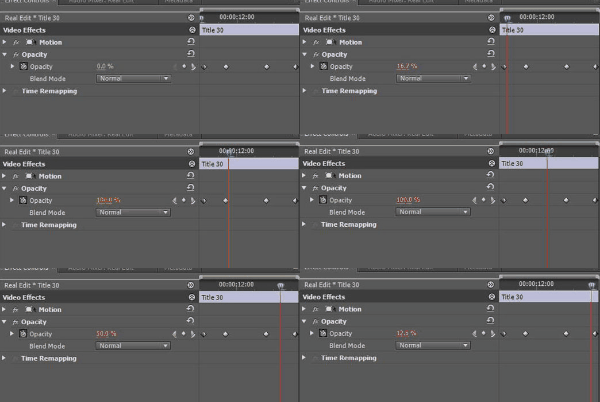
One of the most the most useful skills I learned was how to make titles fade in and out, giving our titles a more professional look. This was done by changing the opacity % at different stages of the title's appearance, as shown below.
The editing is shown on the left and the effect of this can be seen on the right:

Most of our titles were created on adobe premiere pro, however, we created two of our titles using Adobe After Effects. This program was entirely new to me so learning how to use it greatly improved my technical skills. The following title was created by going through the shot frame by frame and drawing a mask around the text in each frame. This made the title disappear as the character runs past:

We also used LiveType to produce the title 'GEMM Productions' and our film title 'Consequences'. This meant that we could apply interesting effects to our titles rather than just fading them in and out. LiveType was very easy to use as it worked in a similar way to the other programs, based around a timeline.


Facebook:
Facebook proved incredibly useful throughout our project. We used it as one of our main ways to communicate with each other when not in school.
How we used Facebook to communicate as a group
(click to enlarge)
We also used Facebook to promote our film and attain audience feedback via Surveymonkey. This proved an especially useful platform as it enabled us to directly target our audience because a large majority lie within our peer group.
Facebook Promotion